
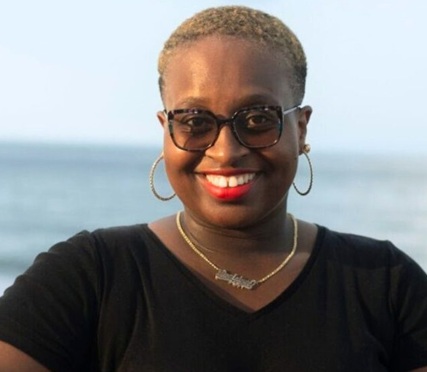
This interview explores the life, literary journey, and cultural impact of Dr. Kevin Anglade, a poet, educator, and doctoral scholar of Africology and African American Studies. Dr. Dominique Carson engages Anglade in a thoughtful discussion about his evolution from writing detective fiction to embracing poetry, his academic path, and how Africology shapes his creative and professional endeavors.
The conversation offers rich insight into the power of art, education, and Black cultural traditions in shaping identity and purpose.
Background
Dr. Kevin Anglade, a native of Southside Jamaica, Queens, New York, is a prolific writer, educator, and recent doctoral studies graduate at Temple University, where he studies hip-hop through the lens of African oral tradition. Holding a B.A. and M.A. in English Literature from CUNY, Anglade also served as an English educator through Teach for America and authored A Flower That Rose, a 2021 poetry collection.
In this interview, Dr. Dominique Carson uncovers the layers of Anglade's personal, academic, and creative life, and his commitment to using language as a transformative tool.
Interview
What made you decide to write poetry? What made you choose to express your art and your creativity through writing?
I remembered that in fall 2011, I was attending Queensborough Community College, which was my final semester. I took a detective fiction writing class, which was excellent. The course delved into the intricacies of detective fiction, its history, and the art of crafting compelling narratives. I had the opportunity to learn about detective fiction, and I found it fascinating.
So, I started writing my own detective fiction stories aside from my classwork. I received a lot of support from my friends, who enjoyed the stories, and I appreciated their feedback. As I graduated and completed that semester in the fall of 2011, I transferred to pursue my bachelor's degree in English at Brooklyn College. I was in Brooklyn, where I was writing detective fiction, but it started to dissipate a little because I wanted to explore other avenues of creative writing.
I recall stumbling across the Brooklyn College Slam team and attending one of their events, where I saw them perform poetry, which was truly amazing. Because of that, I started writing poems. At first, I was not sure if they were that good, but I kept writing. I thought about the challenges, obstacles, and pain that I had endured throughout my life, such as losing my father in fall 2010 and losing my older sister in fall 2007. I realized I could make poetry my outlet for that.
It was also the first time I started reading hip-hop as poetry and began to decode the lyricism from the great artists. I thought, "Wow, I have always listened to this music, but I have always heard it on a surface level."
Sometimes, creatives are very sensitive about their writing, whether creative nonfiction, narrative, or any form of writing. What made you decide to bring your writing to the center stage?
I was still writing detective fiction at the time. I decided to muster up the courage and publish a couple of my detective fiction works because I wanted to take that next step and see what kind of traction they would get. To achieve some form of accomplishment in publishing, I self-published my works.
Once I did that, I truly enjoyed the process. Even though there was not a lot of fanfare at the time, I appreciated the practice, the work that went into it, and the act of doing it. From there, I said that since I had been doing poetry for about three or four years, I should encapsulate all of my poems within a poetry collection.
After stumbling across the Brooklyn College Slam team, I started coming across Black poets who were making huge names for themselves, as well as already established poets with great notoriety. I realized that not only could you do poetry, but many authors publish their work as well. I started writing more and compiling my poetry. In 2016, I published my first poetry collection. My second one was published in 2021, and I have not looked back since.
It was vital to hone your skills as a writer and poet. Why did you attend Brooklyn College out of all of the city universities?
I had my reasons for going to Brooklyn. It was October 2011, and it was such a magical semester for me. It was my last semester at Queensborough, and things started happening for me. There was a college fair in the student union at Queensborough, so I spoke to representatives from both Queens and Brooklyn colleges.
Brooklyn had a great English program and a great creative writing program. I was accepted to both schools, but I received an offer to attend City College as a non-matriculated student and Brooklyn College as a matriculated student. Brooklyn bought me outright, and I went to the campus to register for classes.
What were some of the intricate moments you loved about the college? Did you participate in extracurricular activities related to writing?
I tried to take as many creative writing courses as possible, even though I only ended up taking one. I still enjoyed it because I wanted to be part of a formal class where students could exchange their thoughts and work together.
I also took the initiative to write for one of the newspapers. I went over to the Kingsman and asked if they were looking for writers. I was later told that the paper needed a sportswriter, so I decided to delve into writing sports for them in the fall of 2012.
With all these excellent writing skills and expertise from Brooklyn and Queens College, why teach?
I was pursuing an English major in New York City, and there is not much you can do with it, especially if you are a person of color. I took a college assistant job at an office for the Assistant Secretary at Queensborough. While I was working there for three years, I decided to return to school and enroll in a master's program in English at Queens College.
A friend of mine from elementary school reached out to me. He was part of Teach for America and told me that when you apply, they place you depending on your interests and location. You can be placed anywhere throughout the country.
So, you taught English or Creative Writing?
It was English, ELA. However, I incorporated creative writing into every opportunity I could. I encouraged my students to be creative. Sometimes I would look at the scripts and plays they created in class and think, "Wow, this is good." I tried to help shape and roll out the potential that I saw in them.
I remember every February, except for the Black History unit, I always ensured that not only I, but also my friends from New York City, invited another poet to come to Connecticut.
Now, Ph.D. becomes a priority in your life. Why did you decide to pursue a Ph.D.?
Getting a Ph.D. is not something that just happened all of a sudden. I had been dreaming and envisioning myself as a Ph.D. since 2016. I genuinely fell in love with the process, and I have always had a passion for learning.
I remember delivering a package to the English department while working in the Speech and Communications Theatre Arts Department. I listened to people such as D. Watkins, Dr. Michael Eric Dyson, and Jabril Muhammad speak about race in America and issues pertaining to Black people. It felt as if God told me right there, "I want you to pursue your doctorate."
This time, I applied to Temple University, but not in the English program. I realized that although I had majored in English for my undergraduate degree and completed my master's in English, I wanted to switch my topical focus. I asked myself, "What do I love?" That brought me back to the National Black Writers Conference and to conversations about race relations, politics, and Black people.
To conclude our interview, what are your thoughts on your publishing company, your writing, your teaching, and now your major in Africology? How do you think Africology will reshape your vision and your definition of creative writing, and how do we use the arts to express our creativity to others?
After being accepted to the program, Africology molded and shaped my perspective so that once I graduate, I can utilize it in a way that impacts and changes the world for the better.
The discipline of Africology is a form of Black Studies. Africology presents the study of Africans. When I say Africans, that means everyone in the African diaspora: Africans in Africa, Africans in America, Africans in Guadeloupe, Africans in Haiti, Jamaica, and every part of the world. As long as you are Black, you represent an African. Africology presents the perspective of Africans through their own lens and their own phenomena, not through the views of any other ethnic group.
Conclusion
Dr. Kevin Anglade's journey is a testament to the power of interdisciplinary learning, creative exploration, and cultural grounding. His dedication to Africology, literature, and teaching embodies the potential of using writing not just as art but as activism. Through his work, he empowers others - students, readers, and communities - to find their voices and rewrite their narratives.
Biography
Dr. Dominique Carson, LMP, is an award-winning massage practitioner. She launched her mobile massage business, Mani Benedette (Blessed Hands), in Italian in the spring of 2025, after five and a half years of performing mobile massages part-time. She was the lead massage practitioner at the former award-winning Green Leaf and Pebble Med Spa in Virginia Beach for three years.
In addition to her impact on wellness, Dr. Carson is also an accomplished journalist, orator, and author. The Brooklyn, New York native interviewed over 100 public figures in popular culture, including renowned musicians, actors, pastors, and community leaders. Her ability to tell powerful stories has made her a respected name in the media industry.
Dr. Carson's work continues to inspire future generations of massage therapists, wellness advocates, writers, and public speakers. Her overall mission is to facilitate people's lives with her hands and words.